Understanding Cabinet Solar Dryers for Small and Medium Food Businesses
Wiki Article
Introduction
The demand for practical and resource-conscious food-processing technologies has encouraged businesses to explore alternatives to conventional drying methods. Solar energy is one such resource. When sunlight is converted into useful thermal energy, it can provide heat for suitable drying applications without relying entirely on conventional fuel sources.
A commercial solar dryer is designed for more than occasional household use. It needs to be evaluated around batch capacity, product characteristics, airflow, loading, processing frequency, installation conditions, and the business's overall workflow.
Rudra Solar Energy provides solar drying systems ranging from smaller cabinet configurations to larger commercial systems. Its product range includes configurations from 5 kg per batch to 500 kg per batch and includes a commercial solar tunnel dryer for large-scale continuous dehydration applications.
What Defines a Commercial Solar Dryer?
A commercial solar dryer is generally intended for repeated processing rather than occasional domestic use. The important question is not simply the physical size of the machine but whether its capacity and configuration match the business's production requirements.A food-processing business may need to run multiple batches regularly, while an FPO may process seasonal agricultural produce.
Capacity Is Only One Factor
A large capacity does not automatically mean a system is suitable. The product itself determines many aspects of the drying process.For example, fresh vegetables, sliced fruit, herbs, spices, grains, and pulses have different physical properties and moisture characteristics. Their preparation and loading requirements can therefore differ.
Applications in Food Processing
Commercial solar dryers can be considered for suitable food-processing applications. Rudra Solar Energy describes its solar food processing dryer as an enclosed multi-tray system for suitable prepared fruits, vegetables, herbs, spices, grains, pulses, and other compatible food ingredients. :contentReference[oaicite:23]index=23Its wider solar dryer range also includes dedicated systems for fruits, vegetables, spices, herbs, fish, flowers, grains, pulses, seeds, oilseeds, and other agricultural products.
Why Enclosed Drying Can Be Useful
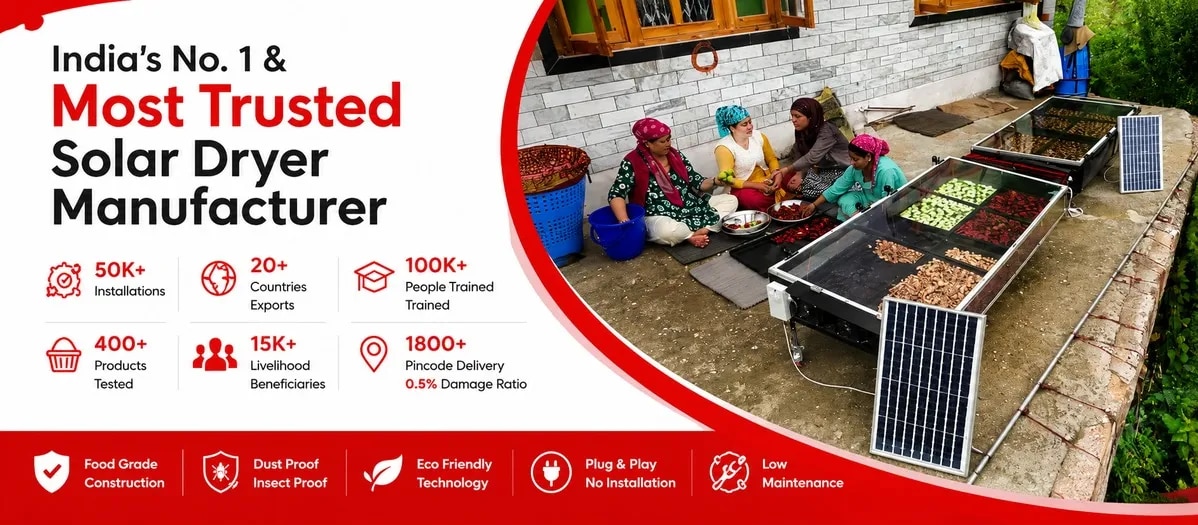
An enclosed system can provide a defined processing environment. Compared with completely open-sun drying, it can reduce direct exposure to dust, insects, birds, and sudden rainfall.Rudra Solar Energy's cabinet solar dryer is described as an enclosed, tray-based system designed for organised drying and reduced direct exposure to outdoor contaminants.
Planning a Commercial Drying Facility
A commercial project should begin with the product and workflow rather than the machine catalogue.The business should identify the fresh quantity expected, the processing season, the desired final condition, and the number of batches required.
Questions for Project Planning
Important questions include:- What product will be processed?
- How much fresh material is available per batch?
- How frequently will the dryer operate?
- What preparation is required before drying?
- What final moisture condition is required?
- How much space is available?
- Is electrical power available?
- Is backup heating needed?
- What packaging and storage system follows drying?
- Can the operation expand in the future?
These questions help determine the appropriate configuration.
Solar Tunnel Drying
For larger commercial operations, a tunnel dryer can be considered where continuous or higher-throughput processing is required. Rudra Solar Energy lists a Commercial Solar Tunnel Dryer under its solar dryer range for continuous large-scale dehydration. :contentReference[oaicite:26]index=26The correct choice between a cabinet system and a tunnel configuration depends on the material, process flow, capacity requirement, available area, labour model, and desired operating pattern.
Cabinet Versus Larger Systems
Cabinet dryers can be practical where batch processing is appropriate. Larger systems may be considered when the business needs greater throughput.The decision should be based on actual production requirements rather than simply comparing nominal machine sizes.
Process Control in Commercial Drying
Commercial processing requires repeatability. A business needs to understand how the product behaves under its selected drying conditions.Drying performance can vary with temperature, humidity, solar radiation, product thickness, loading, airflow, and initial moisture. Rudra Solar Energy's cabinet dryer information specifically notes these variables when discussing drying performance.
Keeping Batch Records
A business can maintain records for each batch, including:- Product type
- Fresh loading quantity
- Preparation method
- Approximate drying conditions
- Processing duration
- Final product observations
- Packaging information
Such records can help operators identify patterns and improve consistency.
Backup Heating and Operating Flexibility
Solar availability changes throughout the day and across seasons. Depending on the model and application, backup heating Know More can provide additional operating flexibility.Rudra Solar Energy lists optional electric or biomass backup on suitable cabinet and agricultural dryer configurations.
The decision to use backup should be based on the required process continuity, local weather conditions, product sensitivity, and operating schedule.
Food Quality and Hygiene
Commercial drying is not only about moisture removal. Food businesses must consider hygiene throughout the processing chain.An enclosed solar dryer can support cleaner handling, but the raw material, trays, preparation equipment, operators, packaging, and storage areas must also be managed appropriately.
Post Drying Handling
Once drying is complete, the product should be handled according to the requirements of the particular food or agricultural material. Cooling, packaging, and storage can be just as important as the drying stage.If a dried Solar Dryer Supplier product is exposed to moisture again during storage, the benefits of drying can be compromised.
Evaluating a Solar Drying Supplier
A commercial buyer should look beyond the basic machine name. It is useful to evaluate whether the supplier can understand the actual product and processing requirement.Rudra Solar Energy's location guidance describes product-specific evaluation involving crop type, product stage, quantity, initial and final moisture, product size, loading depth, processing season, electricity availability, and future expansion.
This type of evaluation is important because a single drying condition cannot be assumed to work identically for every commodity.
Conclusion
Commercial solar dryers can provide businesses with a solar-thermal approach to suitable food and agricultural dehydration. Their usefulness depends on more than nominal capacity. Product characteristics, moisture requirements, airflow, loading, processing frequency, site conditions, hygiene, and post-drying handling all influence the overall system.Rudra Solar Energy Solar Dryer offers cabinet, agricultural, food-processing, and larger commercial solar drying configurations. Businesses considering such equipment should first define their product and production requirements and then evaluate the appropriate dryer configuration.
Solar drying is not a universal replacement for every industrial drying technology. However, where the product and process are compatible, it can provide a structured way to use solar thermal energy for moisture reduction and agricultural value addition.
 Report this wiki page